Do financially strong states raise more money for city infrastructure?
When a city (like Indore, Lucknow, Pune, or Ahmedabad) wants to build better roads, water systems, or public transport, it can raise money directly from investors by issuing Municipal Bonds.
But does a state's overall credit health impact how successful its cities are in that market?
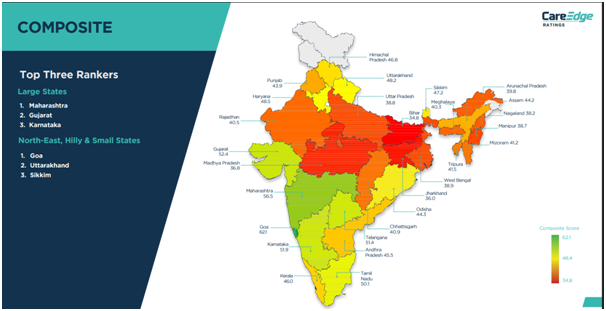
If you look at the State Credit Rankings Map (from State Rankings 2025 by CareEdge Group Ratings) attached below and cross-reference it with historic municipal bond data, a clear story emerges:
1. Moderate scores unlock the gates, but with constraints
States with mid-range scores like Madhya Pradesh (Score: 36.8) and Uttar Pradesh (Score: 38.8) have successfully broken into the market-with cities like Indore, Bhopal, and Lucknow issuing bonds to fund key urban infrastructure projects. However, the data shows that states scoring below this line face a steep barrier, as low-ranking fiscal environments act as a strict gatekeeper for market access.
2. Top-tier scores mean regular market activity
The states highlighted in the deepest shades of teal on the map-like Gujarat (Score: 52.4) and Maharashtra (Score: 56.5)-completely lead the country. Because their administrative and financial systems are incredibly robust, their cities comfortably tap the bond market far more frequently to fund local infrastructure.
3. High scores invite massive investor trust
Stronger financial track records allow states to pull in immense capital volumes. Maharashtra and Gujarat easily crossed the ₹1,000 Crore milestone. While Andhra Pradesh is a massive standout-raising a staggering ₹2,080 Crore-the overarching trend shows that investors place their biggest bets where state fundamentals are highly reliable.
The Bottom Line
Even though cities issue these bonds independently, the "parent state's" financial discipline provides the fundamental backing. If we want to transform more Indian cities with world-class infrastructure, upgrading state-level financial governance is the mandatory first step.